If you’re looking for a walk-through guide to the church interior and its contents please click here.
A quick guide to the history of All Saints’ Highbrook.
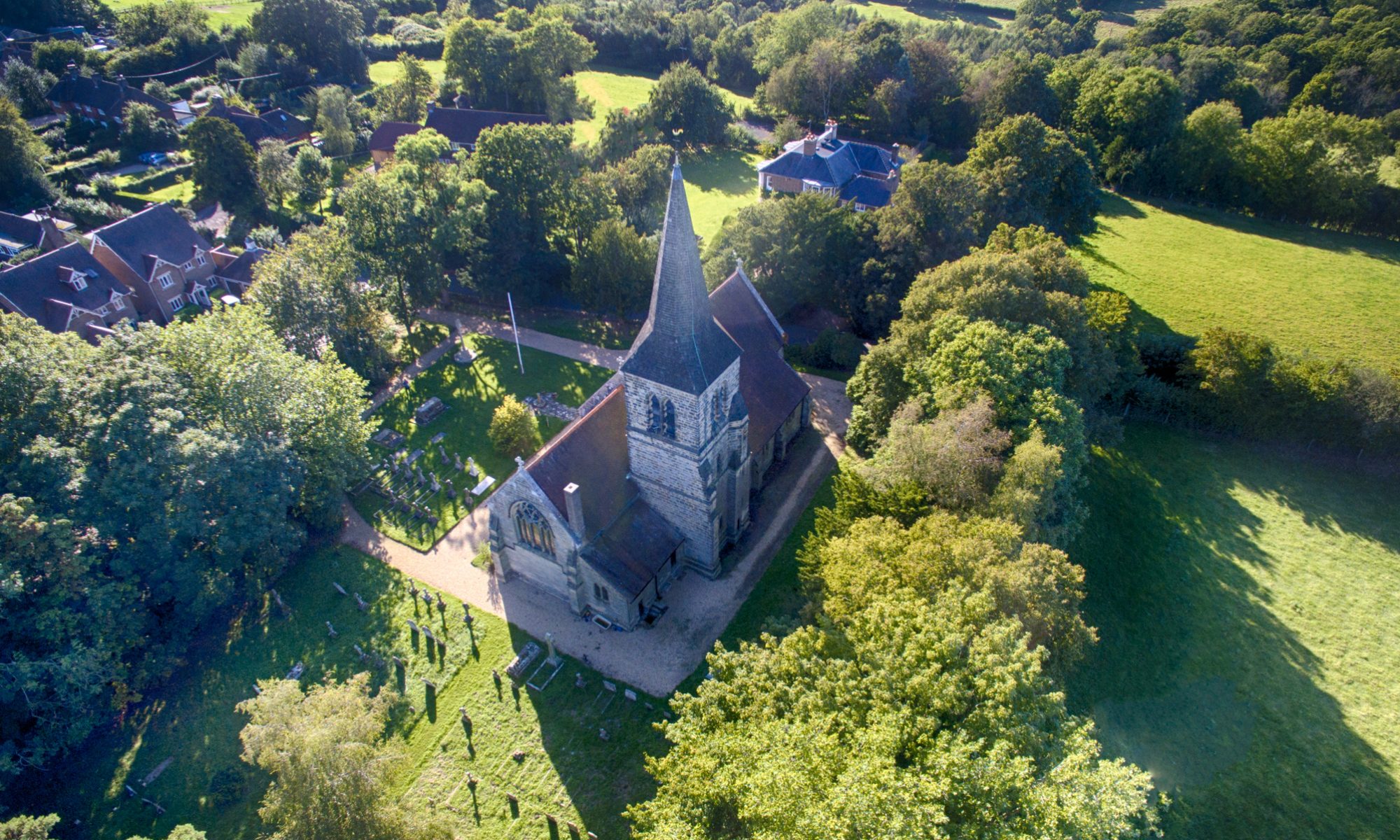
All Saints’ church was consecrated in the autumn of 1884 by The Right Reverend Dr Richard Durnford, Bishop of Chichester. Previously parishioners had to travel to West Hoathly or Ardingly which was an arduous journey in winter.
An ancient settlement, with several hall houses believed to date back to the late 13th or early 14th Century, Highbrook formed part of West Hoathly parish but had no church, chapel or school by the mid-Nineteenth Century when John Blake Kirby and his wife Frances bought Highbrook House. Mr Kirby, a London barrister, died in 1858 and is commemorated in the East window of St. Margaret’s, West Hoathly. After his death Frances Kirby also maintained her London house, in Devonshire Street, and shared her homes with her unmarried sister, Caroline, and her brother William, who had been Vicar of North Stoke, near Arundel, prior to his conversion to Roman-Catholicism.
Caroline began to teach local children, firstly in Highbrook House, then in the Oast House and finally in the new schoolroom (now Highbrook Village Hall) which was built in 1875. A desk, stool and harmonium from the school can still be found in All Saints’ church. The sisters paid The Rev’d Henry Harris to take some Sunday services in the schoolroom as plans for a new church were formed.
Stephenson Clarke of Brook House, a local landowner and business man, joined forces with the sisters to build All Saints’. He donated the field (earlier bought from Mrs Kirby) where the church now stands, and supplied stone to build the church from his quarry in Hook Lane, West Hoathly. The sisters donated £4,000 towards the building and Stephenson Clarke added a further £2,000.
The new parish was created in November 1882 with an annual stipend of £50 for the Vicar funded by Frances Kirby’s donation of £2,500 of Great Eastern Railway Company debenture stock paying 4% per annum. It was formally announced in the London Gazette with the notice including the right of Frances Kirby, her heirs and assigns to the right of patronage (ie appointing the Vicar). Highbrook parish is small, encompassing around 900 acres extending from Cob Lane in the West across the valley, over the Hammingden Lane ridge and down to the stream beneath the church and just over 2 miles at its longest north/south point.
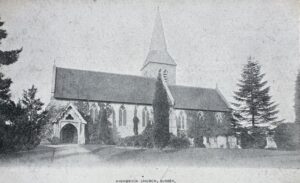
By modern standards the church was built at great speed. Building began in April 1884, with Mrs Kirby laying the foundation stone over a cavity containing a bottle holding copies of the 18th April London Gazette, a copy of the Church Times, the day’s Order of Service and coins dated 1884. George Box, a builder from Ardingly and Mr T Godfrey as Clerk of the Works followed the design of Carpenter and Ingelow, a London firm of architects (who were also involved in the 1870’s restoration of St. Margaret’s). Many years later Pevsner was to describe the early Gothic Revival style building as “a serious job, outside and inside”.
The Rev’d Henry Harris (1884-1904) duly became the first Vicar, since when there have been a further eight incumbents.
Mostyn Williams (1904-1926)
Aikman Wilson 1926-1931)
John Phillips (1932-1937)
Cyril Valentine (1937-1956)
Laurence Browne (1957-1964)
Guy Bowden (1965-1974)
In 1975 the parish was combined with West Hoathly to form a united benefice.
Michael Allen (1975-1991)
Alan Carr (from 1992.)
Lionel Whatley (2012 – 2016)
Nicol Kinrade (2018 – 2022)
Heather Wilkin (2023 to present)
The kneelers in the church were embroidered by a team of local ladies and each one bears the initials of the person who embroidered it.
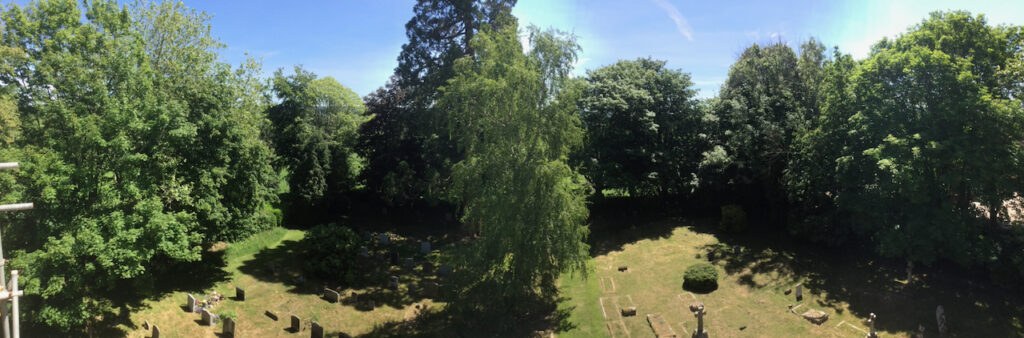
The churchyard contains about 190 graves and a paved area around a sundial. The sundial was put in place in 1974 and the memorials around it are to those whose ashes have been interred there.
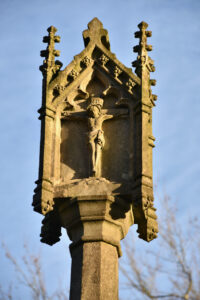
The war memorial was designed by CE Kempe and Co and erected in 1920. It commemorates those lost in the First World War and Second World War.
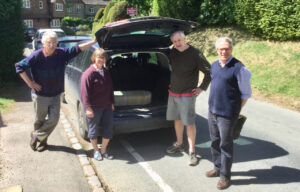
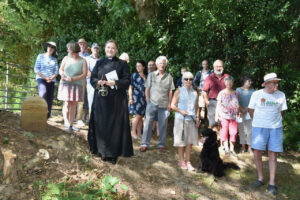
The parish is marked with boundary stones, one of which was replaced in 2019, kindly arranged by John Ralph and donated by Lambs Quarry.
Sources for this page include “Heart & Soul, a History of All Saints Church, 1884 to 2000” M.L.Hodgson.