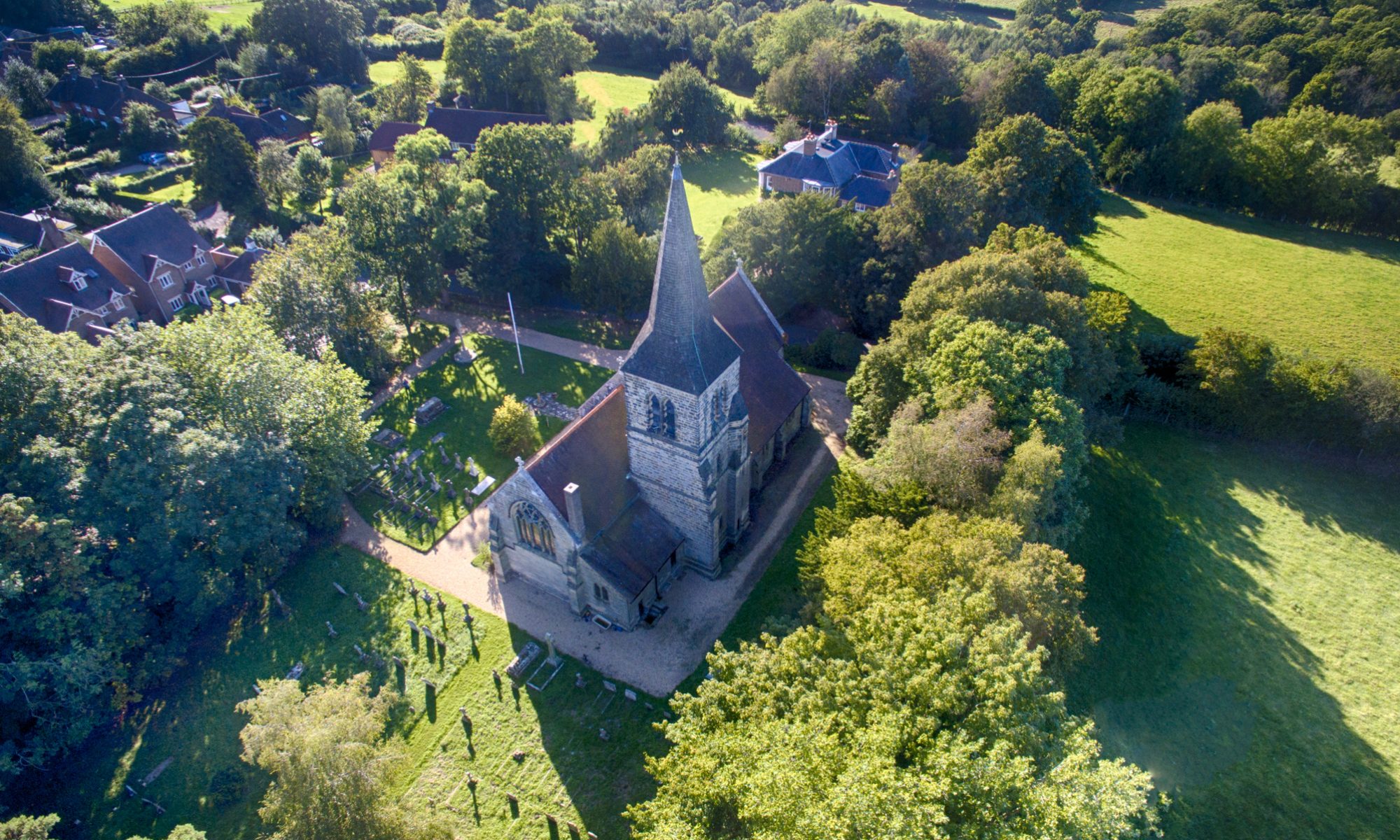
Welcome to the parish church of All Saints’ Highbrook.
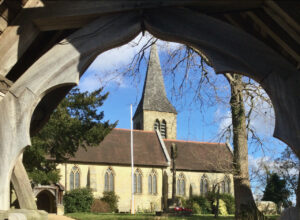
All Saints’ is home to a small but dedicated congregation, many of whom travel from outside the parish to take part in the Book of Common Prayer services using the traditional Church of England form of worship dating from 1662.
Initially an independent parish, since 1975 we have formed part of a Joint Benefice with St Margaret’s, West Hoathly and are part of the Diocese of Chichester.
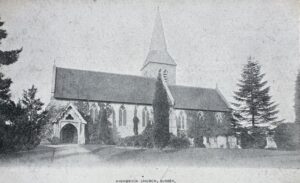
Prior to 1884 there was no church at Highbrook.
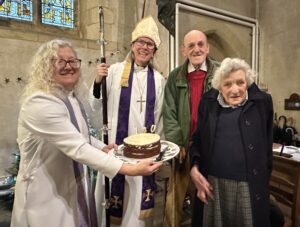
Construction of All Saints’ began in April 1884, with Mrs Kirby laying the foundation stone over a cavity containing a bottle holding copies of the 18th April’s London Gazette, the Church Times, the day’s Order of Service and coins dated 1884. George Box, a builder from Ardingly, and Mr T Godfrey, Clerk of the Works, followed the design of Carpenter and Ingelow, a London firm of architects (who were also involved in the 1870’s restoration of St. Margaret’s) with . Many years later Pevsner was to describe the early Gothic Revival style building as “a serious job, outside and inside”. All Saints’ was consecrated by Dr Durnford, The Bishop of Chichester, in October 1885.
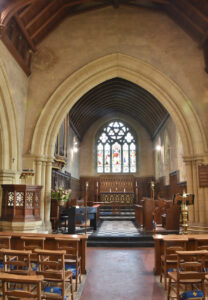
The church is built in what was described at the time as “Early middle-pointed gothic” – a Victorian reinterpretation of fourteenth and fifteenth century English medieval architecture. It was originally lit by a Muller’s gas making device which was replaced by electric light in 1930 put in by the splendidly named Electric Light Super Service Company from London.
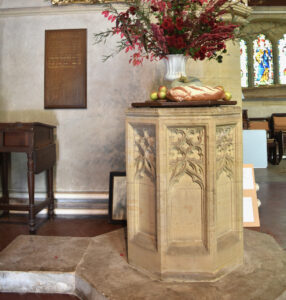
As you enter the church the font, of local sandstone, is immediately in front of you. The schooldesk in the corner is a souvenir of the early school run by Miss Weguelin as is the harmonium against the north wall. Above the font hangs a picture frame with photographs of vicars who served All Saints’ in its first hundred years. Beside this is a monument to the two sisters who created this church.
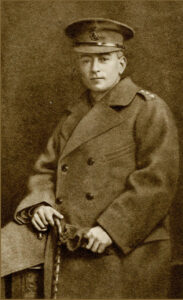
A memorial to John Gay Clarke is by the door. Sixth son of Stephenson Clarke, he was lost in the Battle of Loos in 1915 in the same action and on the same day as John Kipling. John Gay Clarke’s body has not yet been found.
As you walk up the aisle you will see two more Clarke memorials on the wall (including Stephenson Clarke) and when you step up into the chancel there are many more to be found on the left hand wall. The chancel was altered in 1924 and redesigned by CE Kempe and Co. At this point the original stone reredos was replaced by the carved oak one we see today, the floor repaved in black and white marble and the walls were panelled. The reredos is a splendid piece of work, possibly German (CE Kempe & Co often used woodworkers from Oberammegau) and shows Christ and the apostles with their attributes.
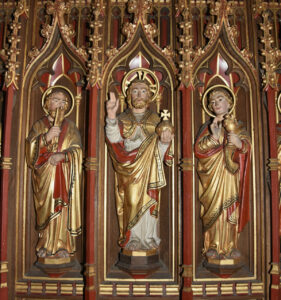
L-R
St Thomas Didymus (Doubting Thomas) Builder’s set square
Saint Matthias Halberd, a symbol of his martyrdom
St Simon Zelotes Canaanite Saw, “ “ “ “ “
St James the Less Fuller’s Staff “ “ “ “
St Andrew Cross “ “ “ “
St Peter Key
Christ
St John The Divine (the Evangelist) Poisoned chalice with Dragon
St James the Great Pilgrim’s scrip (bag)
St Bartholomew (aka Nathaniel) Knife, a symbol of his martyrdom
St Matthew Levi A bag of coins
St Philip A cross
St Jude A lance.
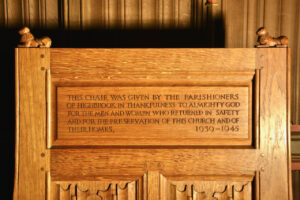
To the right of the altar is an oak Bishop’s chair capped with two sphinxes given in thanksgiving for the return of those who served and returned safely from World War Two. The sphinx may be a reference to the Egypt battle honour earned by the Royal Sussex Regiment. Many bombs fell on the parish between 1939 and 1945 but no people or homes were lost. At least one German plane was brought down in the parish by British fighter planes. On 12th September 1941 a Dornier bomber returning from a raid on Coulsdon crashed at Lower Sheriff killing two of its crew and another German plane crashed yards outside the parish into a farm pond. The two dead airmen were buried in the graveyard of St. Margaret’s West Hoathly before being moved to Cannock Chase German Cemetery in the 1970’s.
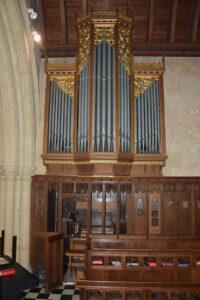
The current organ, made by Morgan and Smith of Hove, was installed in 1920 replacing the original 1884 organ from Jones of London. The organ was originally hand blown from a small chamber in the tower but is now powered by electricity.
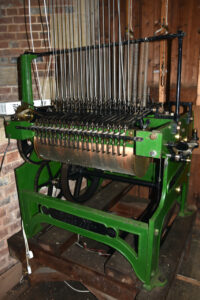
The tower contains a Gillett & Johnson carillon of eight bells presented by Stephenson Clarke as a memento of the Golden Jubilee year of Queen Victoria in 1887. These play a number of tunes or can be plucked by hand. The carillon mechanism requires a lot of day to day maintenance so Peter Browne has kindly transferred the tunes to a computer which can now be heard playing the regular chimes. There is also a swinging bell which can be hand chimed.
As you turn back up the church towards the door take time to notice the unusual lights on the north wall. The Crown of Thorns lights were designed in 1966 by Richard Nickson and two Cross mounts were later made by Mr Cook. Beyond the second light you will see an unusual wooden leaping board grave marker. Used from the fourteenth century onwards these are rarely found beyond the 1870s and (for obvious reasons) very few survive. Cast iron examples may be found at St Margaret’s.
All the kneelers in the church are handworked. Completed as part of the church’s centenary project led by Ruby Rothwell they are each unique designs of animals and plants with the initial of each worker on an edge. There is a key to the initials framed in the NE corner of the church.
The banner hanging just inside the door is that of the Loyal Tooting Volunteers. Raised in 1803 to fight against the French, Ensign Robert Clarke was entrusted with the colours. However the Volunteers never saw action despite being declared fit for action. They were disbanded in 1813 and the colours passed down through the Clarke family before being laid up in All Saints.
The stained glass is all by the prolific London firm Clayton and Bell. It was put in over several decades and several different styles may be observed as you walk round the church. The first stained glass windows were the East window, a memorial to the sisters’ parents and West window, a memorial to Stephenson Clarke’s parents. The beautiful themed windows of the north aisle were inserted five years later, followed in 1892 by the windows illustrating biblical quotes found in the south wall.
John Clayton was the senior partner of the firm and was a leading designer of church windows. His designs may also be seen in mosaics on the reredos of the high altar in Westminster Abbey and in the groups of Continents at the corners of the pediment of the Albert Memorial in Kensington.
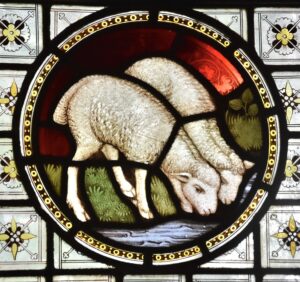
The charming roundels of lambs in the Good Shepherd window are particularly suitable for Highbrook’s rural location.
Before you leave All Saints do take time to walk around our churchyard and enjoy the view across the Horsted Valley where you may catch a glimpse of a steam train passing below on The Bluebell Railway.
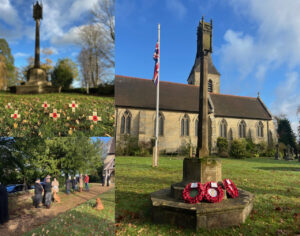
The War Memorial was designed by CE Kempe & Co and dedicated in 1920. Many of those named on it worked at Brook House. After WW2 one more name, that of Bill Funnell, had to be added. The 1939 register finds him working at Brook House as a gardener but he was called up, despite being diabetic, and he was killed in Tunisia.
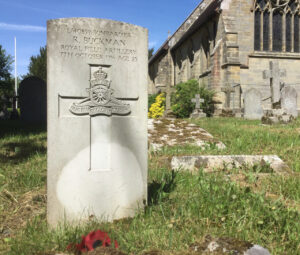
All Saints’ churchyard contains one CWGC grave from WW1. Reginald Buckman was a footman at Brook House, working for the Clarkes. He enlisted in the Royal Field Artillery in 1915 and was posted to France where he was wounded after less than a week at the front. He was brought back to London to the King George Hospital in Stamford Street where he died of his injuries.
Recent work by two of our volunteers uncovered a second memorial on the grave kerb liner, to John Godding. Research has revealed that John and Reginald were half-brothers. They were brought up at Lywood Common, where John remained working as a gardener until he married in 1915 and later enlisted in the RFA. John Godding was killed in action and is buried at Hamel on the Somme. Two more brothers from this family survived the war.
During the Second World War Highbrook and West Hoathly parishes were briefly united.
Dr Valentine, Vicar of Highbrook, took on the care of both parishes until 1949 when he returned to Highbrook. His comments in the parish magazine sound very familiar, problems with the church heating (installed in 1923 at a cost of £300 but clearly struggling just 20 years later), finances and volunteers took up much of his time.
In 1975 Highbrook was united with the parish of West Hoathly as a Joint Benefice. Since then the two parishes have shared one Vicar, with each church run separately by its own PCC.
Today All Saints’ offers the chance to experience traditional Anglican worship using The Book of Common Prayer with Matins, Holy Communion and Evensong offered each month. Visitors are warmly welcomed. Each “Fifth Sunday” the congregations of the United Benefice join together in worship.
We hope you have enjoyed your visit to All Saints’ and that you may return soon to join us here in worship.
We would love to welcome you, whether to our popular Carols by Candlelight or a regular Sunday service.
Details can be found at allsaints-highbrook.org.uk or find us on facebook